Finding Another Way to Write
By Ayoposi Ojelabi
Ayoposi Ojelabi lost the use of his hands to CIDP. Here is how assistive technology let him write again.
I write with my head now.
A few years ago, that sentence would have sounded strange to me. I was a network engineer and had spent much of my working life solving technical problems, working with computers and networks, and communicating through keyboards and screens. Writing was something I could do without thinking about it.
Then I became ill.
When Everything Changed
My symptoms began in Nigeria with weakness, numbness and problems with my balance. After several appointments and investigations, I was eventually diagnosed with chronic inflammatory demyelinating polyneuropathy (CIDP).
I went through different treatments, including steroids, IVIG and plasma exchange, but my condition continued to deteriorate. Eventually, I became so unwell that I spent around ten months in intensive care across four hospitals. What had started as weakness had become something much more serious, affecting my ability to breathe and leaving me dependent on machines and other people for things I had previously taken for granted.
There was a point when I could no longer breathe without mechanical support. I had a tracheostomy and spent a long period on a ventilator, with recovery becoming something measured in very small steps rather than days or weeks. During that time, I underwent further treatment, including chemotherapy and a stem cell transplant, while my body continued to deal with both the illness and the effects of
everything being done to treat it.
Coming out of intensive care did not mean that life immediately became easier. It meant beginning another stage of recovery.
Losing the Ability to Write
One of the things I had lost was the use of my hands.
I could still think, and I still had ideas and things I wanted to write, but thinking and writing had become two completely different things.
For a while, two members of the care staff took turns typing while I spoke the words aloud. I was grateful for their help, but there was a particular frustration in having a thought arrive quickly and then having to wait for someone else to turn it into words on a screen.
It became even harder at night. I could wake at three in the morning with something I wanted to write down, but there might be no one available to type for me. The thought would be there, completely clear in my head, while I had no way of getting it out.
I realized that if I wanted to keep writing, I needed to find another way.
Finding Another Way
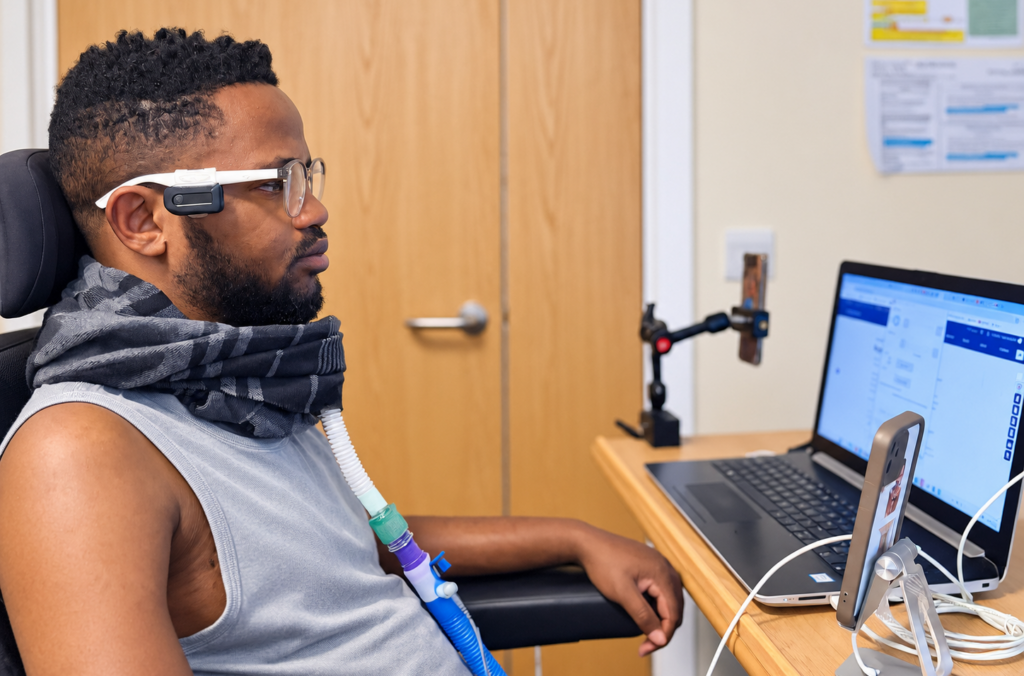
About two months into rehabilitation, I contacted the North West Assistive Technology Service. They introduced me to a head tracking system that used a sensor attached to my glasses. It allowed me to move a cursor, select text and type using movements of my head rather than my hands.
The first time I realized I could move the cursor myself, it felt almost ordinary. It wasn’t. After depending on other people to type my thoughts for me, I could finally do it myself again.
The technology did not restore the use of my hands. It gave me another route around what my body could no longer do.
That distinction has become important to me.
I now use a newer head tracking device, the Quha Zono X. It is not effortless, and there is still a learning curve, but I have become more comfortable with the idea that the way I do something may have to change even when the thing itself still matters to me.
Writing My Way Forward
Writing became more than a way to pass the time.
At first, some of it came from frustration and anger. I wanted to document what was happening to me and make sense of an experience that had changed almost every part of my life. I also wanted to read accounts from people who had been through something similar, but often could not find what I was looking for.
So I started writing my own.
Within seven months of beginning to write independently with assistive technology, I had published two books and launched my website. Since then, I have continued to use the same assistive technology to write my books and essays, design and manage my website, and publish my work independently. Much of the work that now makes up my writing life, from putting my thoughts into words to preparing books and building my online presence, is done through a head tracking device rather than my hands.
That still amazes me, not simply because the books exist, but because there was a period when I could not physically hold a pen or type a sentence without someone else’s help.
Writing gave me back something I had not realized I had lost beyond the physical ability to type: the ability to document my own experience in my own time. It also gave me a way to communicate when my body could no longer communicate in the ways I had always relied on. I have written about illness, recovery, disability, identity, dependence and the experience of rebuilding a life after serious illness.
Some of that writing began as an attempt to understand what had happened to me. Over time, it became a way of connecting with other people who might recognize something of their own experience in what I was writing.
Redefining Progress
The technology did not just help me write a few words. It allowed me to continue developing a part of my identity that illness had almost taken away. It also changed the way I think about recovery.
For a long time, I measured progress against the person I was before CIDP. That was a difficult measurement to live by because there were so many things I could no longer do in the same way.
I have had to learn to measure differently, not against the person I was before diagnosis, but against the person I was last month. That has changed what progress looks like.
I now use a portable Nippy 4 ventilator. I still depend on ventilatory support, but I can now spend a few minutes off it. That might not sound like much to someone looking from the outside, but after everything my lungs and body have been through, tolerating even that amount of time is still progress.
Recovery has not been a neat progression from illness to health. It has been a long series of small changes, some of which are almost invisible unless you know where to look. A few minutes without the ventilator can be progress. Sitting in a wheelchair for longer can be progress. Finding a way to write can be progress. Being able to participate in something that matters to me can be progress.
None of these things means that the illness is finished. They mean that my life is still moving.
Rethinking Independence
That is one of the things assistive technology has taught me. Illness does not always leave room for things to be restored. Sometimes it leaves room for something different: another way of doing something that still matters, once the old way is gone.
For me, that has meant writing.
It has also meant learning that independence does not always look the way I once imagined it would.
Before I became ill, I probably would have described independence as being able to do things without help. I understand it differently now. Sometimes independence means having the right support, the right technology and the right people around you so that you can continue participating in your own life.
I still need help with many parts of daily life. I still have significant physical limitations. I still depend on respiratory support. None of that changes the fact that I can make decisions about what I want to say, write those thoughts down and decide what I want to do with them.
Another Way Forward
The technology did not make me the person I was before CIDP. It helped me continue being myself after CIDP had changed what my body could do.
There are still things I cannot do, and there are still days when progress feels frustratingly slow. Recovery has not given me back the life I had before illness in the form I once expected. But it has given me the ability to keep building a life with the body and circumstances I have now.
I have published books, built a website and continued writing about the experience of living through illness and recovery, all through a process that would not have been possible for me without assistive technology.
That is what I want people to understand about technology and disability. Sometimes the most important thing technology can do is not restore what was lost, but make another way forward possible.
I write with my head now. And for the moment, that is enough to keep me writing.
About The Author
Ayoposi Ojelabi is an author and patient voice essayist living with CIDP. He writes about illness, recovery, disability, identity, and the ways people adapt when life changes unexpectedly. He is the author of Still Here, Finding Strength in Numbness, and Through Fire and Silence, as well as the children’s book When Daddy Works, written especially for his daughter Tiara. He also writes regularly at ayoposiojelabi.com.
Disclaimer: All information provided by or in affiliation with the Foundation for Peripheral Neuropathy (FPN) is shared for informative and educational purposes only. This information should never be used to diagnose or treat a medical condition, which can only be done by a qualified health care provider. FPN is not a medical provider, our staff are not medical professionals and no doctor-patient relationship exists between the FPN and any individual. We strongly recommend that those suspecting or diagnosed with peripheral neuropathy should see a qualified neurologist. No new approach to any medical condition should be implemented without the prior approval of the individual’s personal physician.