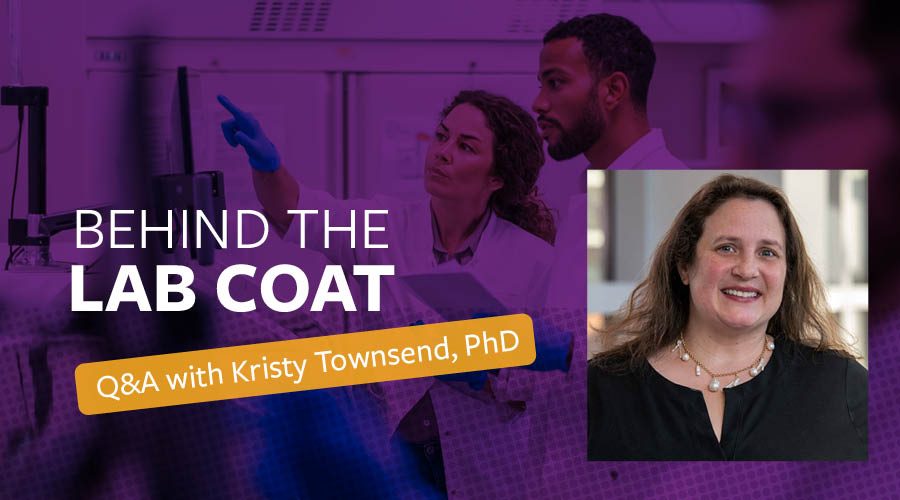
Behind the lab coat: Q&A with Dr. Townsend
“Science is a team sport” – Kristy Townsend, PhD
Dr. Townsend recently spoke on our webinar, Behind the lab coat: How medical research really works.
Kristy Townsend, PhD is a researcher and Professor in the Department of Neurological Surgery at The Ohio State University’s College of Medicine. Research in the Townsend Lab for Neurobiology & Energy Balance focuses on neural plasticity (remodeling and regeneration) versus neurodegeneration, and how the brain and nervous system impact appetite, metabolism, and energy expenditure (calorie burning). The lab conducts basic/foundational, translational and clinical research on peripheral neuropathy. Dr. Townsend is also vice president of the FPN Board of Directors.
We sat down with Dr. Townsend to answer more of the questions submitted during the program’s live Q&A.
- In your professional opinion, how close are we to a cure for PN?
It can be hard to estimate based on ongoing clinical trials that are still underway and not fully analyzed or published yet, but given the pipeline for new innovations leading to therapies that are now (or will be soon) tested in a clinical setting, I am very optimistic. However, a new FDA approved therapy may not work well for all patients with PN, and thus research is still needed to ensure we have a robust and effective treatment landscape for this condition into the future.
- What breakthrough(s) in neuropathy research are you most hopeful for?
Prevention may be more effective than treatment at the end of the day, so research toward better biomarkers and diagnostics that can ensure we catch those at highest risk, and identify the earliest signs of peripheral nerve degeneration, will be crucial to maintain a healthy nervous system.
- Any new research on neuropathy that repairs the nerves?
In pre-clinical models, there are definitely studies showing this is possible, including in my lab. However, a mouse is not a human, even though it can be an excellent tool for studying mammalian physiology overall, and for early proof-of-concept studies that test new innovative approaches in medicine. We still need to support research that brings these discoveries from rodent to large animal then to human – the key to translational research! And remember – animals can get neuropathy too! So veterinary benefits as we test these new therapies will also likely be realized in parallel to human applications.
- What is the current status of the research on idiopathic peripheral neuropathy?
Some forms of idiopathic neuropathy are due to aging, including across the menopause transition, and this is an area of active research for myself and others. Other idiopathic causes may be underlying genetic predispositions, environmental exposures, or other causes we still do not understand. As with all of PN, we need more research so we can more effectively address this condition for all forms of PN.
- Any knowledge of research on electrical treatments and their success?
My team is actively testing whether a form of neuromodulation, spinal cord stimulation, can improve small fiber neuropathy with diabetes beyond its known impacts on pain mitigation. Time will tell, and other forms of neuromodulation are also under investigation by other research teams around the world. As data become available, they will enter the research literature, and until then, information on ongoing trials in the US can be found at clinicaltrials.gov. Even negative data (showing the hypothesis was proven incorrect) will be informative to move this research field forward. Rigorously designed studies with recruitment of sufficient participants and appropriate endpoint measures are key to testing new outcomes. Substantial funding is needed for these types of studies in the clinic to be done robustly.
- How are subjects recruited and vetted for clinical trials?
All clinical trials have an approved institutional review board (IRB) protocol that includes a plan for recruitment of study participants. Recruitment methods are outlined in the protocol (ex: study ads on the patient chart, social media or newspaper announcements, etc.), and the criteria for including or excluding patients are also outlined. Participants need to match these criteria in order to be given the informed consent to discuss their interest in enrolling in the study.
- Why are diabetic and cancer-related PN often included in trials, but other causes like trauma-induced PN?
Sometimes this is purely due to the number of patients with these types of PN – diabetes (which we now can broaden to ‘metabolic’ since it impacts not just diabetes – type 1 and type 2, but also pre-diabetes and obesity), and CIPN are two of the top causes of PN overall. Other times it may be due to funding restrictions and inability for other types of PN, or studies focused on all PN broadly, to obtain sufficient funding.
- For patients who don’t qualify for trials, how else can they make an impact?
Advocacy is key! Support the FPN, donate to research, use your voice with funding agencies and the federal government, and educate your community about the prevalence and dire need for better clinical options for those with PN and their families.
- What is the best way to find a clinical trial? Should we rely on our physician?
Physicians may be informed on trials, especially if they are at an academic medical center where trials are ongoing, but otherwise you can check your patient chart for potential notifications, do a Google search for notices/ads, or visit clinicaltrials.gov and search for ‘peripheral neuropathy’.
- How do you ensure safety and ethics in clinical trials?
Numerous laws and regulations, as well as institutional policies for data and sample handling, ensure the ethical protection and safety of human subjects in clinical research. For example, from my webinar slides you can learn more about the institutional review board (IRB), informed consent, HIPAA, and the food and drug administration (FDA). These are just some of the many safeguards.
- If a treatment is discovered, does the effectiveness of the treatment depend on how long a patient has had PN?
Perhaps. Research and clinical observations do indicate that many forms of PN are degenerative and progressive, getting worse over time. This may mean that there is a ‘critical window’ when therapies will be more effective, underscoring the importance of early and sensitive diagnosis of PN. However, each treatment or therapy may be unique in this, and research will be informative as time goes on and we test these new discoveries in specific populations and clinical settings.
- Where can you access the results of a clinical trial you participated in?
Once a research study or trial is completed, the research team will typically publish their results in a peer-reviewed journal article. This can take months to years to prepare the publication and go through the peer review process. Many articles are available as ‘open access’ without a subscription, or you can request article PDFs via interlibrary loan. Sometimes preliminary results are shared at research conferences and symposia to gain input from leading experts in the field, and these are sometimes shared as short ‘abstracts’ online.
- Which institutions are leading neuropathy research?
Many large research universities are conducting neuropathy research, but overall, this condition is under-funded and more dedicated research support from foundations, donors/alumni, and federal agencies will ensure that more research can be done across the country. Check out the large academic medical centers near you for more information.
- How is the research you do in your lab typically funded?
We have funding from the federal government (ex: NIH), foundations, and industry – it depends on the project. Some projects in our lab, and in other labs, hold significance for improving our understanding of neuropathy but are challenging to get funded, for various reasons.
- What does a typical day look like in your lab?
As the lab head, or ‘principal investigator’ (PI), my day includes academic administrative tasks, lab management tasks, meetings with colleagues and collaborators, and my favorite part of any day – meeting with my lab members to discuss experimental planning, data analysis, or preparation of grants or research articles. Once a week we have lab meetings with all members of our lab, from undergraduate research assistants to grad students and postdocs, and research staff or visiting scientists. At these meetings, someone presents the status of their research project, and we discuss troubleshooting, optimization of methods, and interpretation of findings that will inform the next hypotheses. We also discuss and critically analyze recent research articles in our field and cover any ‘lab business’ (equipment needing servicing, lab cleaning days, updates to lab protocols, etc.). Every day is different, intensely busy, and requires a lot of task-switching, To Do lists, and energy. I love this part of running a research team in academic medicine!
Thank you for your expertise, Dr. Townsend! Continued progress in PN depends on strong support for research like hers. Each year, we advocate for increased funding to advance new discoveries. Research like this depends on that support to move forward. Donate today to help bring new treatments to people living with PN!